pyAVS

pyAVS is the companion Python package for the Active Visual Semantics (AVS) dataset. This dataset combines MEG and eye-tracking data recorded while participants visually explored natural scenes, along with structural MRI scans acquired before the first MEG session. By focusing on active vision, it moves beyond the passive, fixation-enforced viewing paradigms used in most existing neuroimaging datasets.
5 participants 10 sessions each 4,080 scenes 200,000+ fixation epochs 306-channel MEG 1000 Hz eye tracking
What Is AVS?
Note
AVS is described in Sulewski, Amme, König, Hebart & Kietzmann (2026), currently available as a preprint (arXiv:2609.01055) – see Citation. The summary below is drawn from that paper’s abstract.
Unlike existing neuroimaging datasets that rely on passive viewing with enforced central fixation, AVS captures brain activity during active scene exploration, including self-generated saccades and fixations, across five participants who freely explored 4,080 natural scenes over 10 sessions each. A semantic captioning task on 25% of trials links gaze to scene understanding and memory. Alongside neural and behavioural data, AVS includes per-fixation object category labels, human-rated caption-relevance annotations, pupil dynamics, and individual head-stabilization casts paired with structural MRI scans for precise cross-session source reconstruction.
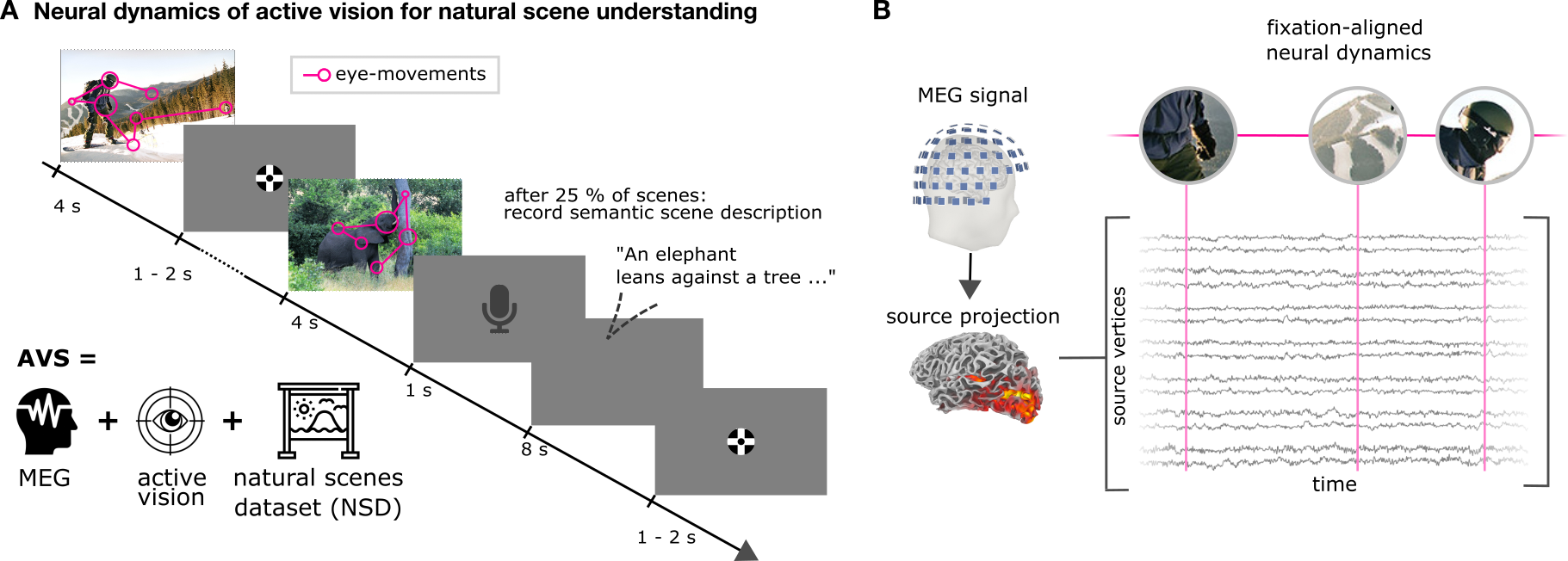
Dataset design combining MEG recordings and eye tracking with natural scene understanding. Adapted from Sulewski et al., 2026.
Getting Started
Install pyAVS and configure your local copy of the dataset.
Key numbers, modalities, and a task-oriented “what do I need?” guide.
Load MEG + eye-tracking data and build your first epochs in a few minutes.
The full dataset is loadable on demand from AWS. How to download only the parts you need.
Citation
If you use the AVS dataset or pyAVS, please cite the dataset paper:
Sulewski, P., Amme, C., König, P., Hebart, M. N., & Kietzmann, T. C. (2026). Active Visual Semantics: A large-scale MEG and eye-tracking dataset for understanding visual intelligence in action. arXiv:2609.01055 [q-bio.NC].
See Citation for the full citation, BibTeX, and how to cite the software.
Contributors
Philip Sulewski, Carmen Amme, Peter König, Martin N. Hebart, and Tim C. Kietzmann. Corresponding: phsulewski@gmail.com, tim.kietzmann@uni-osnabrueck.de.