Stimuli
Scene Set
Stimuli comprised 4,080 natural scenes drawn from the Natural Scenes Dataset (NSD; Allen et al., 2022), including NSD’s shared-1000 subset (presented to all NSD participants) and the special-100 subset (chosen to maximally span the NSD semantic space).
Semantically Balanced Sampling
Because internet-sourced image collections such as NSD/MS-COCO over-represent commonly
photographed scene types, stimuli were sampled to give AVS uniform coverage across semantic
content. Sentence-BERT embeddings (paraphrase-multilingual-mpnet-base-v2) were computed
for the five MS-COCO captions available per scene and averaged; the resulting embedding
space was partitioned into 60 clusters via K-means, with the number of clusters selected via
a cross-validated silhouette criterion. 68 scenes were then sampled uniformly from each of
the 60 clusters, giving 4,080 scenes with balanced semantic coverage.
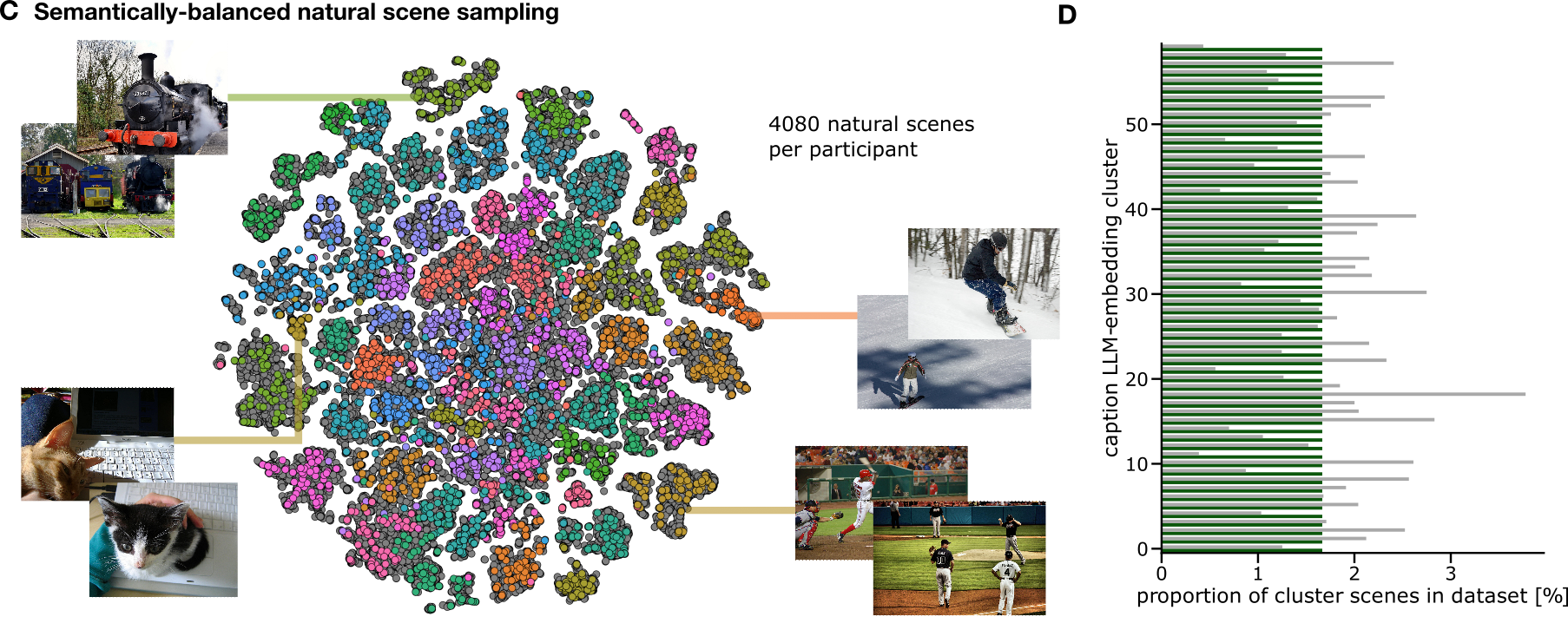
Balanced semantic scene sampling approach. Adapted from Sulewski et al., 2026.
All participants viewed the same stimulus set, each in an individually randomized order.
Presentation
Scenes were cropped and resized to 947 x 710 pixels (preserving aspect ratio) and displayed on a 41.6 x 31.2 cm screen (1024 x 768 pixels) at a viewing distance of 70 cm, subtending 28.5 x 21.6 degrees of visual angle. Each scene was shown for 4 seconds, followed by a 1-2 second inter-stimulus interval.
On 25% of trials (selected pseudorandomly but fixed across participants), a microphone icon appeared for 1 second after scene offset, cueing the verbal scene-description task (see Semantic Captioning Task), followed by an 8-second response window.